
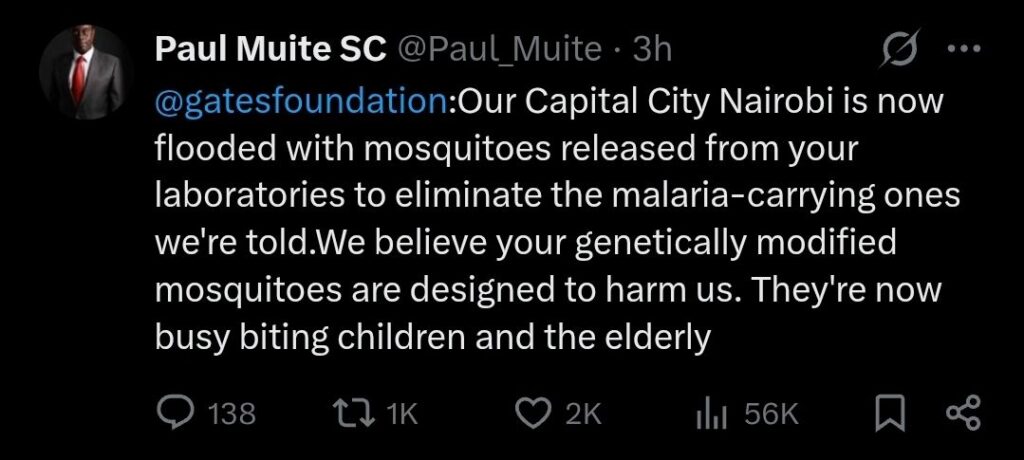
Prominent Kenyan lawyer and Senior Counsel Paul Muite sparked widespread discussion with a pointed accusation directed at the Bill & Melinda Gates Foundation.
Through his official X account, Muite claimed that Nairobi, Kenya’s capital, is now “flooded with mosquitoes” released from the foundation’s laboratories.
He asserted these are genetically modified mosquitoes intended to eliminate malaria-carrying ones but alleged they are designed to harm Kenyans and are aggressively biting children and the elderly.
The post, which garnered thousands of likes, reposts, and views, taps into longstanding conspiracy theories surrounding billionaire philanthropist Bill Gates and his foundation’s global health initiatives.
The Gates Foundation has long funded research into innovative malaria control methods, including the development and testing of genetically modified mosquitoes in parts of Africa.
These efforts, often in partnership with organizations like Target Malaria or Oxitec, aim to reduce populations of disease-transmitting mosquitoes—such as by releasing sterile males or those carrying traits that suppress malaria transmission.

However, there is no evidence of any Gates Foundation-supported release of genetically modified mosquitoes in Nairobi or Kenya. Malaria vectors are historically low in Nairobi due to its high altitude, and no official reports confirm such a program there.
Similar claims linking Gates-funded projects to increased mosquito activity or harm have repeatedly been debunked in other contexts, including U.S. malaria cases.
Muite’s post reflects broader skepticism in some Kenyan circles toward foreign-funded health interventions, amid ongoing urban mosquito challenges possibly linked to climate, flooding, or sanitation issues.
While the foundation’s work has contributed to malaria reduction globally, such allegations highlight persistent distrust and the need for transparent community engagement in public health innovations.

Author: Bashirjuma
About The Author