
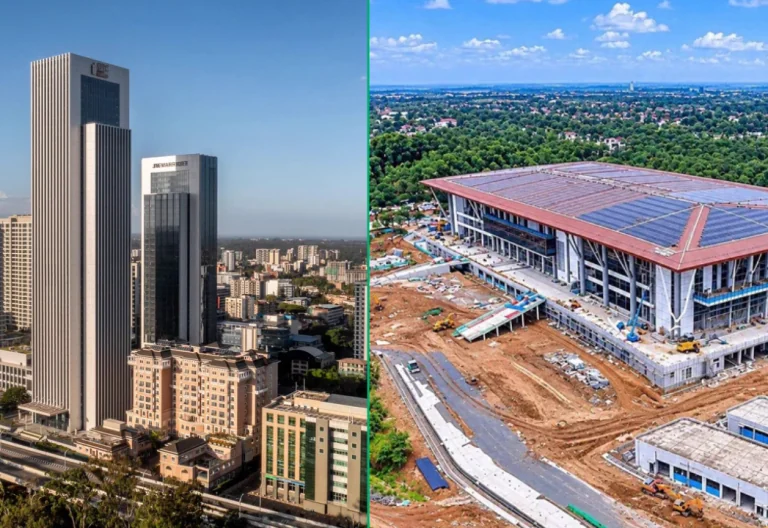
President William Ruto’s economic adviser David Ndii has defended the controversial KSh45.1 billion Bomas International Convention Complex project, arguing that critics are making unfair comparisons with Nairobi’s Global Trade Centre (GTC).
However, his explanation has failed to address several questions surrounding the project’s rising cost, procurement process, financing arrangements and construction delays.
In a post on X on Tuesday, November 17, 2026, Ndii challenged comparisons between Bomas and GTC Tower, saying the two developments differ significantly in size.
He stated that the Bomas complex covers approximately 324,000 square metres, compared with 147,000 square metres for the entire GTC complex.
According to Ndii, comparing the two projects based only on their overall construction costs without considering their respective sizes could lead to misleading conclusions.
However, critics argue that a meaningful comparison requires similar measurements, construction specifications and a clear breakdown of the facilities included in each development.
Bomas project cost rises from KSh31.7 billion
One of the major concerns surrounding the project is the increase in its estimated cost from approximately KSh31.7 billion, which was approved by Cabinet in August 2023, to the reported KSh45.1 billion.
This represents an increase of about KSh13.4 billion, raising questions about the factors behind the revised expenditure.
Treasury documents have also placed the wider development’s estimated cost at approximately KSh42 billion, with the first phase estimated at KSh31.5 billion.
The figures relate to different project components and arrangements, making a detailed financial breakdown necessary to establish exactly what taxpayers are expected to fund.
Auditor-General raises procurement concerns
The project’s procurement process has also attracted scrutiny from the Auditor-General.
In a report covering the financial year ended June 30, 2025, the Auditor-General flagged the timing of approval for direct procurement.
According to the report, approval was granted on February 17, 2025, despite procurement proceedings having already commenced, with tender invitation documents and a site visit certificate dated February 13 and 14.
The audit found that the process was contrary to Section 69(2) of the Public Procurement and Asset Disposal Act, 2015.
The report further identified differences between the contractor’s repayment arrangements and the financing approval issued by the National Treasury.
While the construction contract provided for nine instalments within 24 months, Treasury had approved a 10-year deferred payment arrangement.
The Auditor-General warned that the government could face additional penalties and charges if payments were delayed.
Senate demands access to construction contract
The accountability questions have also reached Parliament, with senators demanding comprehensive documents explaining how the project was procured, financed and implemented.
Tourism Cabinet Secretary Rebecca Miano previously told senators that her ministry owns the project and oversees its funding, while the Ministry of Defence holds the main construction and procurement documents.
The arrangement raised concerns among lawmakers, who questioned why the ministry responsible for funding and overseeing the project could not immediately provide the construction contract.
Senators have demanded access to the contract, financing agreements, procurement records, invoices, payment records, feasibility studies, bills of quantities and approved designs.
Construction delays and funding shortfall
Beyond the financial and procurement concerns, the project has also faced questions over its implementation timeline.
Reports indicated that the complex was approximately 38 per cent complete as of June 2026, despite having an initial completion target within the 2025/26 financial year.
The completion deadline was subsequently pushed to December 31, 2026.
Funding has also emerged as a challenge. During the 2025/26 financial year, Bomas reportedly received KSh1.5 billion against a grant target of KSh4.6 billion, leaving a shortfall of KSh3.1 billion.
The project is intended to position Nairobi as a major destination for international conferences, exhibitions and business tourism.
The proposed facility is expected to accommodate up to 11,000 delegates through its conference halls, auditorium, banquet facilities and other supporting infrastructure.
Although Ndii’s argument highlights the importance of considering the size of a development when comparing construction costs, questions remain over the increase in the project’s budget, procurement compliance, financing structure and delays.
For taxpayers, the bigger concern is whether the government can provide a clear account of how the KSh45.1 billion will be spent and demonstrate that the investment will deliver value for money.