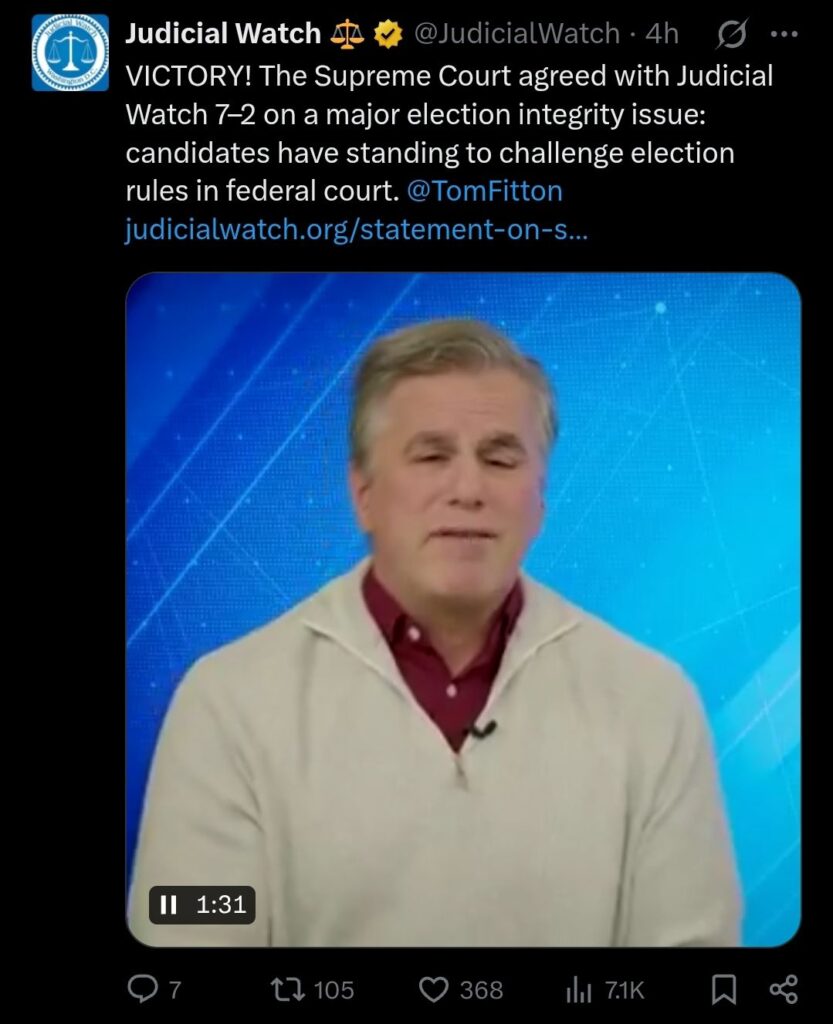
The U.S. Supreme Court ruled 7-2 that political candidates have standing to challenge election rules in federal court.
The decision, issued in the case Bost v. Illinois State Board of Elections, reverses lower court dismissals and affirms candidates’ right to sue over procedures they believe undermine fair elections.
The case centered on an Illinois law allowing mail-in ballots postmarked by Election Day to be counted up to 14 days later.
Republican Congressman Michael Bost, represented by Judicial Watch, argued this practice violates federal election standards.
Lower courts had dismissed the suit, ruling Bost lacked standing because he couldn’t prove the rule would directly affect his electoral chances.
Chief Justice John Roberts, writing for the majority, rejected that narrow view. He stated that candidates possess a “concrete and particularized interest” in vote-counting rules, distinct from the general public’s, regardless of whether those rules harm their prospects or raise campaign costs.

This inherent stake in election integrity and the democratic process grants them standing to sue preemptively.
The ruling, hailed by Judicial Watch President Tom Fitton as “the most important Supreme Court election law ruling in a generation,” could pave the way for more challenges to post-election ballot acceptance and similar practices.
Justices Amy Coney Barrett and Elena Kagan concurred in the outcome but not the broad reasoning, while Justices Sonia Sotomayor and Ketanji Brown Jackson dissented, warning of potential floods of litigation destabilizing elections.
This decision strengthens candidates’ ability to contest alleged unlawful election procedures early, potentially reshaping how voting laws are litigated ahead of future contests.

Author: Bashirjuma
About The Author