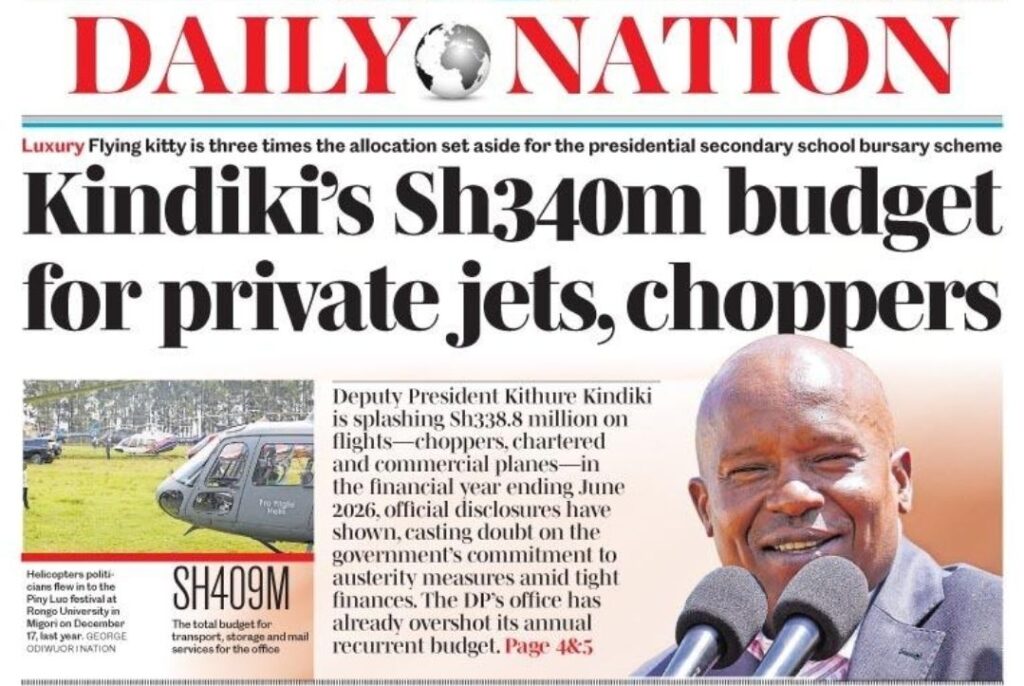
The Daily Nation headline on January 30, 2026, has ignited fresh debate over government spending priorities in Kenya amid ongoing economic pressures.
Deputy President Kithure Kindiki’s office has allocated approximately Sh338.8 million (often rounded to Sh340 million in reports) for air travel in the financial year ending June 2026.
This covers chartered flights, helicopters, and commercial planes, forming part of a broader Sh409.66 million budget for transportation, storage, and mail services.
The figure has drawn sharp criticism because it exceeds—by more than three times—the Sh100 million set aside for the Presidential Secondary School Bursary Scheme, a key initiative to support needy students’ education.
Critics argue this highlights a disconnect between austerity rhetoric and actual expenditure, especially as the DP’s office has already overshot its recurrent budget in prior periods.
The spending includes Sh150.2 million earmarked for helicopter services (with portions reserved for women, youth, and persons with disabilities suppliers), Sh144 million for commercial aircraft, and Sh44.6 million for chartered jets.
While official travel is essential for a high-ranking leader covering vast distances, the scale raises questions about value for money and alignment with fiscal restraint promises.
Public reaction on social media has been mixed, with some defending the necessity of efficient mobility and others decrying it as extravagant amid tight national finances.
This disclosure underscores persistent tensions in balancing executive needs with public welfare priorities in Kenya’s budget landscape.

Author: Bashirjuma
About The Author